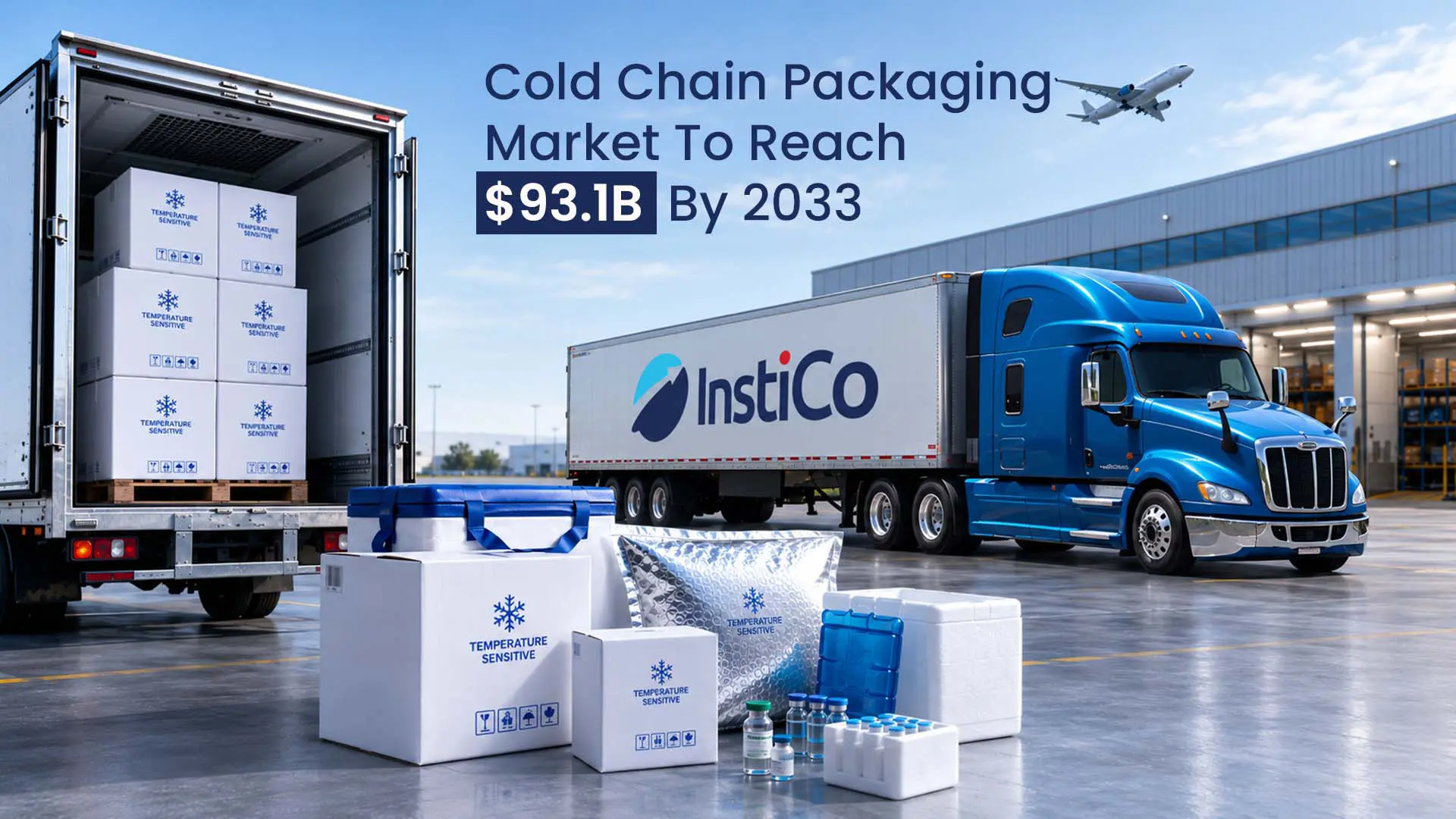
The humble shipping box is becoming a $93 billion battleground. For supply chain leaders, this is no longer simply a packaging story but a risk management story, as pharmaceutical products, biologics, specialty foods, and other temperature-sensitive shipments become more valuable, making cold chain packaging a critical part of transportation strategy rather than an operational afterthought. The cold chain packaging market is projected to grow from $33.7 billion in 2025 to $93.1 billion by 2033, according to a new report from Grand View Research. Expected to expand at a 13.5% CAGR, the market is being driven by booming biopharma production, stricter shipping regulations, and a food supply chain that increasingly moves fresh products across continents.
For years, packaging was an afterthought, the last decision made after freight rates and carriers were locked in. That’s no longer the case. A few hours of temperature drift can ruin a shipment of vaccines, seafood, or specialty drugs, and companies are starting to treat the box itself as a strategic asset rather than a shipping cost.
Why the Cold Chain Packaging Market Is Set for Rapid Growth
The companies that will be most successful over the next decade won’t treat cold chain packaging as another line item in the transportation budget. They’ll treat it as part of their overall supply chain strategy, where every shipment represents a balance between product protection, regulatory compliance, customer expectations, and cost. We have seen enterprises underestimate the impact of cold chain performance on product quality and profitability, even though a single temperature excursion can compromise a shipment of vaccines, seafood, biologics, or specialty pharmaceuticals within hours.
As these high-value, temperature-sensitive products continue to grow, the need for reliable cold chain packaging will only increase. That is why analysts expect the cold chain packaging market to grow at a 13.5% CAGR through 2033, driven not by packaging alone but by the increasing value of what is inside the package, alongside biopharma expansion, stricter regulations, and a food supply chain that now moves fresh products across continents.
Key Drivers Behind the Cold Chain Packaging Market by 2033
It’s easy to assume that pharmaceutical demand is driving the entire cold chain packaging market. While it’s certainly one of the biggest contributors, it’s far from the only one. Several long-term trends are reshaping how temperature-sensitive products move through global supply chains. According to Grand View Research, the market’s projected growth is being fueled by:
- The rapid expansion of biologics, vaccines, and cell and gene therapies requires tightly controlled temperature ranges and strict thermal stability.
- Continued growth in global food exports, grocery e-commerce, and demand for fresh, frozen, and refrigerated products.
- Increasing regulatory expectations, including FDA Current Good Manufacturing Practices (CGMP), Good Distribution Practices (GDP), and other quality standards governing temperature-sensitive shipments.
- The continued shift toward direct-to-patient pharmaceutical delivery models places even greater importance on maintaining product integrity throughout transportation.
In 2025, North America accounted for more than 32% of global market revenue, driven by strong biopharma innovation and sustained demand for temperature-sensitive pharmaceuticals.
The common thread across all of these trends is simple: the products being shipped are becoming more valuable, more specialized, and less forgiving of transportation mistakes. As that happens, packaging is no longer just a protective container. It’s becoming an essential part of supply chain risk management.
Trends Defining the Future of Efficient Cold Chain Logistics
The challenge is not whether a company can ship temperature-sensitive products. It is whether its temperature-controlled transportation can do so consistently, cost-effectively, and without unnecessary material waste. Three trends are reshaping how companies approach cold chain logistics.
Reusable Cold Chain Packaging Market Gains Momentum
The goal isn’t simply sustainability. It’s reducing lifecycle costs while improving consistency across repeated shipments. Environmental concerns, the high cost of replacing single-use foam boxes, and Europe’s push toward reusable and modular systems under circular economy initiatives are accelerating the adoption of reusable cold chain packaging. Companies that invest in reusable shippers can often reduce overall packaging costs across multiple shipments while improving long-term operational efficiency.
Smart Packaging Improves Visibility and Temperature Control
Technology creates visibility. Strong operating processes turn that visibility into better decisions. Sensors don’t prevent temperature excursions; prepared teams do. As high-value shipments increasingly rely on real-time sensors and data loggers, organizations need the procedures and operational discipline to act on the insights those tools provide. Too often, companies invest in monitoring technology but fail to establish the processes needed to respond effectively, limiting the value of the data and leaving temperature-sensitive shipments exposed to avoidable risks.
Sustainable Materials Transform Cold Chain Packaging
The rate of growth for paper and paperboard insulation is the highest of all in the cold chain packaging material market, at 14.8% per year, through 2033. Close behind will be vacuum-insulated panels, which are forecast to increase at a 14.2% per year rate as pharma/biotech customers seek longer thermal hold times in smaller, lighter packages.
Regional Growth Across the Global Cold Chain Packaging Market
North America accounted for more than 32% of global cold chain packaging revenue in 2025, making it the largest regional market, according to Grand View Research. Asia Pacific is projected to be the fastest-growing region, at roughly 15% CAGR through 2033, supported by expanding cold storage infrastructure and e-commerce grocery delivery across markets including China and India.
Region | 2025 Position | Growth Driver |
North America | Largest share (32%+) | Biopharma, FDA/GDP compliance |
Asia Pacific | Quickest growing (~15% CAGR) | Cold storage buildout, e-commerce |
Europe | Strong reusable adoption | EU GDP rules, circular economy |
How the Pharmaceutical Cold Chain Packaging Market Is Evolving
Within the broader cold chain packaging market, the pharmaceutical end-use segment is expected to grow at a 16% CAGR through 2033, making it the fastest-growing end-use segment, according to Grand View Research. Cell and gene therapies, biologics, and other specialty medicines leave little room for error, requiring highly controlled transportation environments where packaging performance directly affects product integrity. Recent investments, such as ThermoSafe’s expansion of vacuum-insulated panel manufacturing in the U.S., further highlight the industry’s shift toward greater domestic production, tighter quality control, and reduced reliance on overseas sourcing.
What the Market Means for Shippers and Supply Chains
The growth of the cold chain packaging market reflects a larger shift in supply chain strategy. Organizations are moving away from viewing packaging as a commodity purchase and toward treating it as part of an integrated risk management strategy. Businesses that continue to treat packaging as a commodity are more likely to face spoilage, compliance issues, and avoidable losses.
In contrast, organizations that view it as a strategic supply chain investment are better positioned to reduce spoilage, improve regulatory compliance, strengthen customer confidence, and lower total supply chain costs over time. The question is no longer, “What’s the least expensive package?” It’s “What packaging solution best protects the product, controls costs, strengthens customer trust, and supports the business?”
How InstiCo Logistics Supports Modern Cold Chain Operations
We believe successful cold chain transportation requires more than selecting the right package. Packaging, carrier selection, routing, monitoring, documentation, and communication all work together to protect product integrity. At InstiCo, we help shippers connect packaging decisions to their overall transportation strategy because addressing only one part of the cold chain, whether it’s packaging, routing, carrier selection, or last-mile handling, often creates unnecessary risk. Reliable cold chain performance depends on a chain of integrated systems. Because in cold chain logistics, success isn’t determined by the box alone. It’s determined by the system supporting it.
Conclusion
The projected growth of the cold chain packaging market to $93.1 billion by 2033 reflects a fundamental change in how organizations manage temperature-sensitive products. As pharmaceutical therapies become more specialized, food supply chains become more global, and customer expectations continue to rise, packaging will play an increasingly important role in transportation performance. Companies that succeed won’t simply invest in better packaging. They’ll build integrated cold chain strategies that combine validated packaging, qualified logistics partners, real-time visibility, reusable systems, smart monitoring, sustainable materials, and disciplined execution from origin through final delivery. Those who delay risk continued spoilage, compliance issues, and rising transportation costs.
At InstiCo, we help customers develop transportation strategies that protect product quality, reduce operational risk, and strengthen long-term supply chain performance. If your business ships temperature-sensitive products, we’ll help you build a cold chain strategy based on proven systems rather than guesswork. Because in cold chain logistics, success isn’t determined by the box alone. It’s determined by the system supporting it.