There’s a threshold in every growing business where “we’ll figure it out” stops being a strategy and starts being a liability, and that’s exactly when logistics management services become a necessity, not a choice. Then a second warehouse opens, then a third, and all of a sudden, inventory doesn’t match, shipments misroute, and the team is firefighting instead of operating. In the Geodis Supply Chain Worldwide Survey, only 6% of companies have full visibility across their supply chains.
This guide is meant to bridge that gap with centralized control, real-time visibility, and infrastructure that grows with you. We will look at the planning, the technology, and the findings that distinguish corporations that grow smoothly from corporations that mature painfully.
What Exactly Are Logistics Management Services?
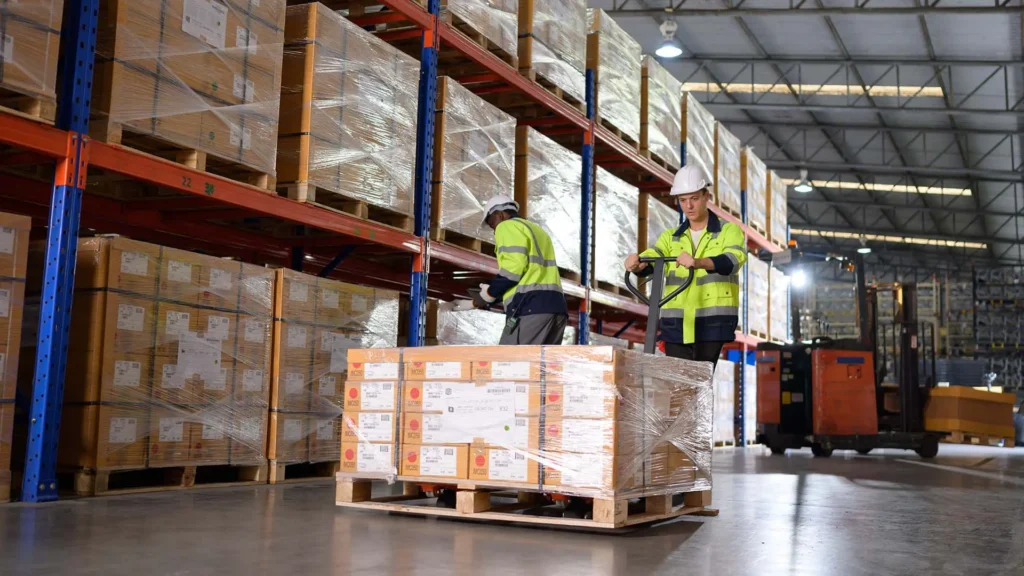
Logistics management services include the planning, implementation, and control of merchandise flow across your supply chain network. This covers inbound and outbound activities, from warehousing to transportation. In our experience with multi-warehouse operators in the manufacturing, retail, and food and beverage industries, the scope of these services is often broader than most businesses initially expect.
This includes activities such as the use of warehousing services, transport services, inventory management, order management, managing carriers, and other technological applications. The effective use of these services ensures that products flow smoothly while maintaining cost control and customer satisfaction.
What is essential when running businesses with more than one location? In this situation, logistics management services ensure that fragmented decisions made at each site are replaced by coordinated decision-making processes.

How Logistics Management Services Enable Multi-Warehouse Growth
Running one warehouse is hard. Running several? That’s a whole different challenge. As businesses expand, so does the need to maintain timely, connected, and optimally stocked stores across all locations. It is where logistics management services come in to save the day for businesses of all sizes, especially for those aiming to grow but suffer from the chaos of inadequate logistics.
Centralized Inventory Control
A centralized system will give you the current stock status at each and every store. Pontoon inventory can be rebalanced in days, and you never oversell or run out of stock.
Optimized Shipping Routes
Compelling logistics management decides which warehouse to ship an order to. It means that freight is saved and products are delivered to customers sooner.
Scalable Infrastructure
Rebuilding systems is not required each time a new site is added. Logistics structures are robust and expandable.
Logistics Planning and Management Services Explained
You can’t walk into a garden without a plan. Businesses can rely on logistics planning and management services to make the most suitable network design from the beginning.
Here are the elements of a typical strong logistics plan:
Planning Area | What It Covers |
Network Design | Warehouse placement, coverage zones, transit times |
Demand Forecasting | Forecasting seasonal and regional requirements for inventory |
Transportation Planning | Mode selection, carrier vetting, route optimization |
Risk Management | Plans in place for disruption, vendor delays, or capacity problems |
Technology Integration | Combining WMS, TMS, and ERP solutions |
Managed Logistics Services vs In-House Management
Many firms start their trade by having their own logistics. Yet, as they grow, this can become more pricey and hard to handle.
In-House Logistics Management Services:
- Complete management of operations
- Needs a lot of investment in employees, software, and equipment
- Each new warehouse introduces complexity and overhead
Managed Logistics Services:
- Having access to specialized expertise without having to build it up from scratch
- Adaptable and expandable with minimal capital expenditures
- Technology and carrier networks are already in place
Comparing both, it concludes that if you want to scale your business, then logistics-managed services can be a great idea.
Managed Transportation and Logistics Services Providers
This is something we talk to operations leaders about all the time, and the truth is, it depends on where you’re at in your growth curve. For most multi-warehouse businesses, however, the numbers tell the story. In these situations, logistics management consulting services can be of great help.
Managed transportation and logistics services providers mostly include the following:
- Carrier management: Vetting, onboarding, and managing carrier performance
- Rate optimization: Getting the best rates across modes and lanes
- Freight tracking: Track from pickup to delivery
- Reporting and analytics: Data that assist you in making better decisions
Technology in Logistics Service Management
Technology is the foundation of today’s logistics service management. If not, multi-warehouse operations are virtually impossible to run efficiently without it. These are the platforms that are instrumental to the industrious progress:
Warehouse Management Systems (WMS)
A warehouse management system (WMS) manages the real-time tracking of inventory and picking and packing processes and links warehouse operations to shipping and billing.
Data Insight: According to the 2025 3PL Industry Statistics by Mintsoft, 86% of 3PLs are now utilizing a WMS. Real-time inventory tracking (87%), operational efficiency (75%), and more accurate orders (71%) were the three most common reasons for adopting.
Transportation Management Systems (TMS)
A TMS controls the freight side, routing, routing selection, shipment tracking, and freight audit. It’s directly integrated with your WMS for end-to-end visibility.
Artificial Intelligence and Predictive Analytics
AI supports logistics teams in forecasting demand, pinpointing potential delays, and optimizing routes proactively before issues arise, turning from a nice-to-have to a competitive must.
Data Insight: Stellar MR’s 2025 Logistics Market report revealed that 94% of 3PL respondents agree that AI is the most pervasive technology in logistics, compared to 62% in 2020.
Common Challenges and How to Overcome Them
The friction was felt in even the best multi-warehouse operations. What we most often see and what does work to correct it is the following:
Challenge: Product movement around different locations. Solution: Execute a centralized inventory system and automation for inventory replenishment.
Challenge: Inconsistent carrier performance. Solution: With regular carrier scorecards and SLA tracking, everybody is held accountable.
Challenge: Slow onboarding for new warehouse locations. Solution: Standardized operating procedures and pre-integrated technology for faster new site launch.
Challenge: Lack of real-time visibility. Solution: Purchase a TMS and WMS with real-time data sharing between sites.
Companies that succeed over competitors do not have fewer problems; they simply solve them more quickly.
Tips to Optimize Multi-Warehouse Logistics Operations
These are not just suggestions; they are recommendations for eminent logistics service management. They are practices they have seen that have a measurable impact in real multi-warehouse situations:
- Run regular audits of your network: Ensure your warehouses persist to make sense as you evolve with your customers.
- Consistent processes: SOPs are standardized, errors are underestimated, and training is shorter.
- Invest in integration: If each system communicates with the others, it saves time and reduces manual effort.
- Schedule ahead for busy times: Multiple warehouses require a longer lead time during busy times.
Conclusion
Multi-warehouse growth isn’t just a logistics challenge; it’s a systems challenge. And the businesses that scale it well aren’t necessarily the largest or the best-funded. They’re the ones that invest in the right operational infrastructure before the cracks show up.
At InstiCo Logistics, we’ve established that foundation for companies in industries such as manufacturing, retail, food and beverage, pharma, and so many more. If you currently operate multiple warehouses or plan to, we’d love to chat. Ask for custom logistics management services, and let’s talk about what it really takes to scale your operation.
FAQs
What documents are required for air freight shipping?
The most critical document is the Air Waybill (AWB), which acts as a receipt and a contract. You will also need a Commercial Invoice, a Packing List, and potentially a Certificate of Origin depending on the destination.
Is air freight suitable for perishable or fragile goods?
Yes, it is the preferred method for these items. The shorter transit time reduces the risk of spoilage for perishables, and the reduced handling compared to sea shipping makes it safer for fragile items.
Is air freight more expensive than sea or road shipping?
Generally, yes. Air freight charges are higher because of fuel costs and the limited capacity of aircraft. However, you can often save money on insurance and warehousing, which offsets some of the initial costs.
What is the difference between air cargo and air courier services?
Air courier is typically “door-to-door” and handles smaller parcels with all-in-one pricing. Air cargo is usually “airport-to-airport” for larger shipments and requires a freight forwarder to manage the “last mile” and customs.
Can small businesses use air freight services?
Absolutely. Many small businesses use air freight to maintain low inventory levels and respond quickly to customer demand without needing a massive warehouse.