For decades, the decision to shift freight from road to rail was a simple calculation: if the distance exceeded 700 miles and the timeline wasn’t “yesterday,” you chose intermodal. But in 2026, the landscape of intermodal logistics has shifted. Relying on basic “per-mile” comparisons is no longer enough to protect your margins.
Today’s supply chain leaders are looking deeper, moving toward sophisticated intermodal transport logistics models that account for everything from carbon taxation to the hidden “friction costs” of equipment imbalances. To truly optimize your spend, you need a cost model that looks beyond the linehaul.
The Evolution of the Intermodal Cost Model
Traditionally, shippers compared the all-in truckload rate against the rail linehaul plus fuel. While that math still provides a baseline, it ignores the operational realities that dictate the success of intermodal freight transport and logistics.
Modern modeling requires a “Landed Cost” approach. This doesn’t just look at the price to move a container; it looks at the cost of the inventory sitting inside it, the reliability of the drayage legs, and the administrative burden of managing multiple handoffs.
1. The Real Cost of “The Last Mile” (Drayage Logistics)
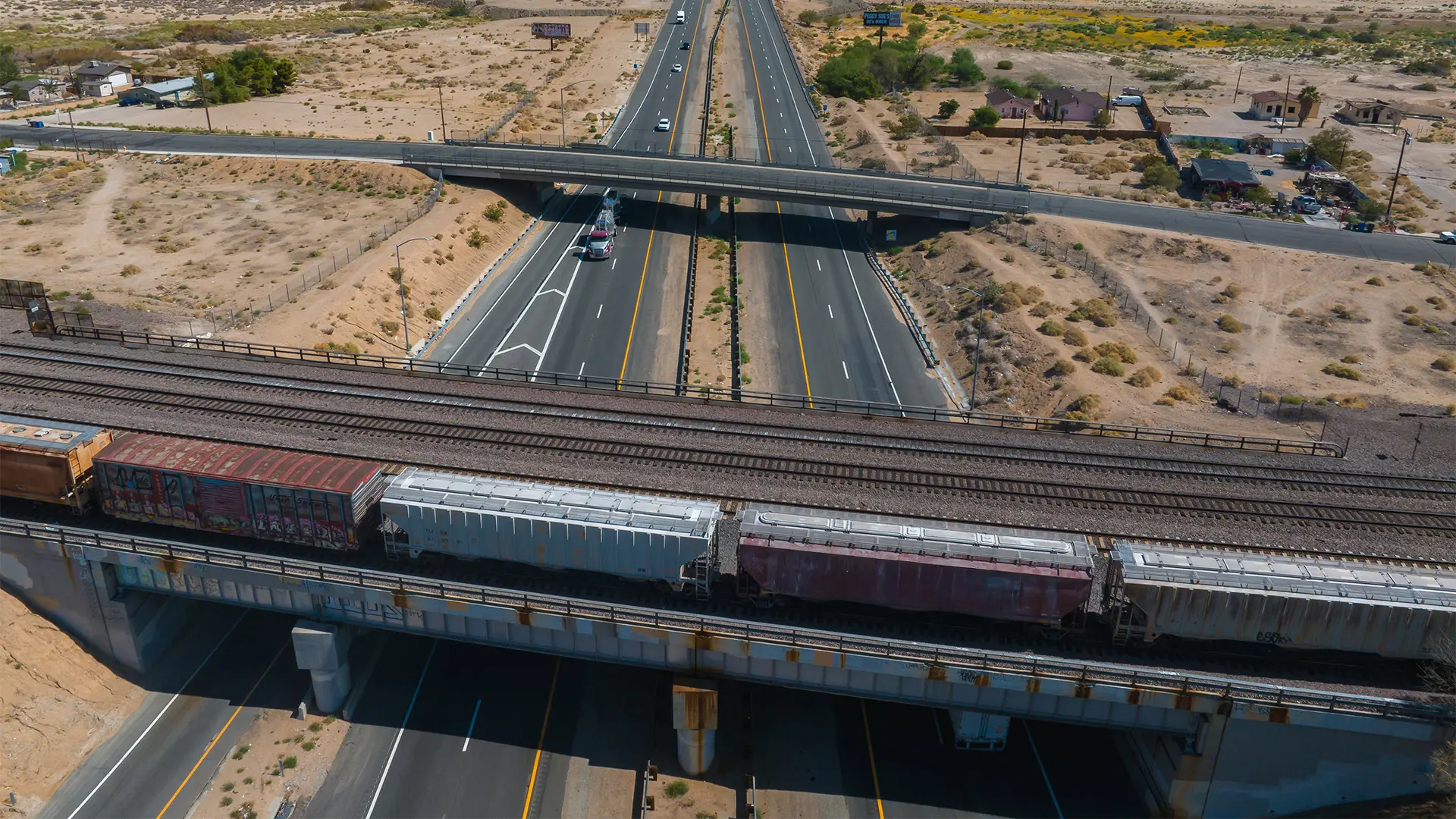
In intermodal container logistics, the rail portion is often the most stable. The volatility lives in the drayage, the short-haul trucking that moves the container from the port or rail ramp to the final destination.
A “cheap” rail rate can quickly become an expensive nightmare if your intermodal logistics services provider hasn’t secured reliable drayage capacity. High-performance models now factor in:
- Gate Timing and Congestion: Costs associated with wait times at congested terminals.
- Chassis Provisioning: The “hidden” fee of intermodal equipment logistics, where the availability (or lack thereof) of a chassis can trigger storage fees or “split-dray” charges.
2. Inventory Carrying Costs (ICC)
Speed isn’t just about meeting a customer deadline; it’s a financial variable. If intermodal adds three days to your transit time compared to a direct truck, your capital is tied up for an extra 72 hours.
Total\ Logistics\ Cost = Transportation\ Cost + (Inventory\ Value \times ICC\ \% \times \frac{Days\ in\ Transit}{365})
In high-value commodity sectors, a 20% savings on freight rates can be completely erased by the interest and opportunity cost of slower transit. Expert intermodal logistics solutions balance this equation by selecting specific “premium” rail lanes that mimic truckload speeds.
3. Equipment & Positioning Dynamics
One of the most overlooked aspects of intermodal equipment logistics is the cost of “repositioning.” The rail industry is a giant puzzle of equipment balance. If you are shipping into a “dead zone” where containers rarely go, you will pay a premium to get that equipment back to a hub.
Conversely, if you can provide “backhaul” volume for a carrier, your cost of intermodal transportation can drop significantly. Smart modeling identifies these geographic imbalances to find “pricing unicorns.”
Why “Simple” Math Fails in 2026
Standard calculators often fail to account for accessorial volatility. In the world of intermodal transport logistics, fees like demurrage (storage at the ramp) or per diem (late container return) can scale exponentially.
Cost Factor | Truckload (Standard) | Intermodal (Complex) |
Fuel Surcharge | High sensitivity to diesel | Lower sensitivity (Rail efficiency) |
Handling | Low (Door-to-Door) | Moderate (Cranes/Transfers) |
Accessorial Risk | Detention only | Storage, Per Diem, Chassis, Flip fees |
Sustainability | High Carbon Footprint | ~60-75% Lower Emissions |
By integrating these variables, shippers can move from reactive booking to a proactive intermodal logistics strategy.
Engineering Reliability with InstiCo Logistics
At InstiCo Logistics, we don’t just provide quotes; we engineer outcomes. We understand that the true cost of intermodal transportation isn’t found on a spreadsheet—it’s found in the execution.
Our approach to intermodal logistics solutions combines high-tech visibility with high-touch service. We specialize in:
- Precision Drayage Coordination: Minimizing dwell time at ramps to eliminate storage fees.
- Mode Optimization: Analyzing your entire network to find where intermodal container logistics provides the best ROI.
- Equipment Strategy: Leveraging our deep network to ensure intermodal equipment logistics never become a bottleneck for your freight.
Whether you are looking to reduce your carbon footprint or insulate your budget from the volatility of the spot truckload market, our team provides the data-driven insights you need to win.
Stop guessing on your freight spend.
Contact InstiCo Logistics today for a comprehensive Intermodal Cost Audit and see how we can optimize your supply chain beyond the basic math.
FAQs
What documents are required for air freight shipping?
The most critical document is the Air Waybill (AWB), which acts as a receipt and a contract. You will also need a Commercial Invoice, a Packing List, and potentially a Certificate of Origin depending on the destination.
Is air freight suitable for perishable or fragile goods?
Yes, it is the preferred method for these items. The shorter transit time reduces the risk of spoilage for perishables, and the reduced handling compared to sea shipping makes it safer for fragile items.
Is air freight more expensive than sea or road shipping?
Generally, yes. Air freight charges are higher because of fuel costs and the limited capacity of aircraft. However, you can often save money on insurance and warehousing, which offsets some of the initial costs.
What is the difference between air cargo and air courier services?
Air courier is typically “door-to-door” and handles smaller parcels with all-in-one pricing. Air cargo is usually “airport-to-airport” for larger shipments and requires a freight forwarder to manage the “last mile” and customs.
Can small businesses use air freight services?
Absolutely. Many small businesses use air freight to maintain low inventory levels and respond quickly to customer demand without needing a massive warehouse.