In the volatile global economy of 2026, the traditional “gut-feeling” approach to logistics has become a relic of the past. In a world where consumer behavior is changing at record speed, and the geopolitical climate is increasingly unpredictable, there is one question on every C-suite executive’s mind: Can AI in supply chain logistics really predict demand better than human intuition?
The answer is an unequivocal yes. With the global AI in supply chain market estimated to surpass US$ 22.7 billion by the year 2030, the technology isn’t an experimental “nice-to-have”-it’s very much the backbone of resilient operations.
The Shift: From Reactive to Proactive Supply Chains
Historically, demand forecasting was based on past sales and linear regression models. Though this served well in stable markets, the models were simply catastrophic in “Black Swan” events that took place in the early 2020s. Right now, AI in supply chain management is changing how we approach challenges. Instead of just reacting to problems as they arise, we are now focusing on planning and strategy, which leads to better results.
Traditional methods tend to have problems with “lag,” where they react to what happened last month rather than responding to what is likely to occur in the coming week. Modern AI solutions and supply chain management rely on Machine Learning (ML) capabilities that analyze millions of data points, ranging from weather patterns and social media trends to port and economic metrics.
Why AI Predicts Better
The superiority of AI in logistics and supply chain stems from its ability to handle “non-linear” relationships. For instance, a human planner might know that summer increases ice cream sales. However, the AI model is capable of determining that for a certain “2°” temperature increase in a certain ZIP code, accompanied by the presence of a festival in that region and competitor stockout, the demand increase for a certain vegan flavor would be 22% greater.
The Core of Precision: AI in Supply Chain Optimization
The primary goal of any logistics manager is to balance the “Golden Triangle”: service levels, inventory costs, and lead times. This is where AI in supply chain optimization excels.
By applying advanced predictive analytics, companies are seeing unprecedented gains:
- Error Reduction: According to the latest reports from McKinsey, applying AI-driven forecasting can reduce errors by 20–50%, helping supply chain leaders feel assured about AI’s reliability in cutting costs and improving accuracy.
- Inventory Efficiency: Organizations have achieved a decrease in inventory levels, freeing up vital working capital.
- Cost Savings: Integrated AI in supply chain and logistics has led to a consistent 15% reduction in overall logistics costs.
Enter the Era of Agentic AI in Supply Chain
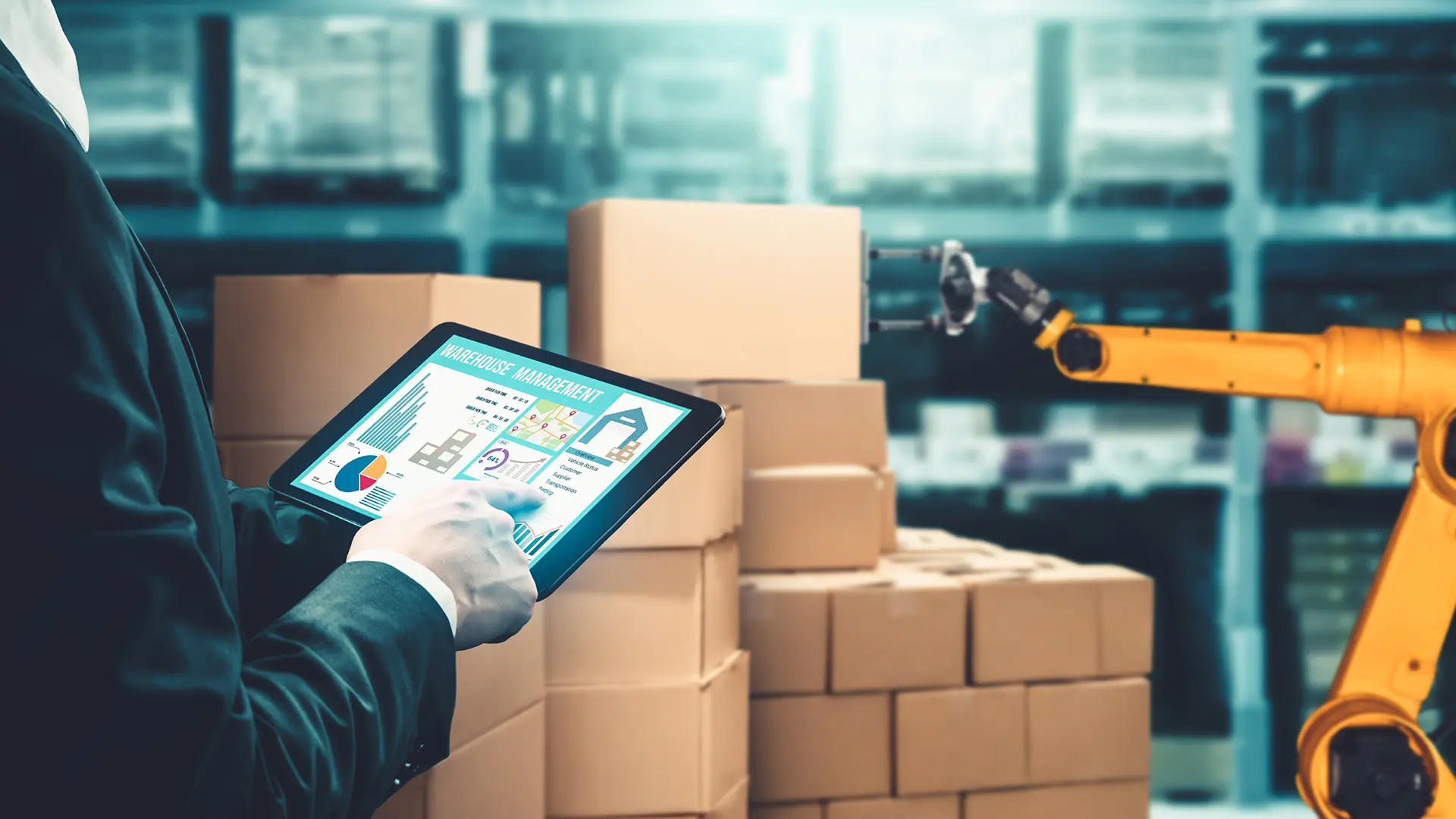
As we move through 2026, the conversation has evolved from simple “predictive AI” to agentic AI in the supply chain. While predictive AI tells you what will happen, Agentic AI takes the next step and acts on it.
Agentic AI enters the realm of “autonomous agents” capable of discussing with suppliers, re-routing deliveries in the face of a surprise storm, and adjusting warehouse staffing schedules without human assistance. Such enablement technology would be the foundation for the bright future of AI in supply chains, turning logistics into a transformative asset rather than an expense.
Vital Abilities of Agentic Systems
Autonomous Rerouting: Identifying when a port strike has occurred and automatically switching volumes to air freight.
Dynamic Sourcing: Immediate changeover to the secondary source when the primary source’s lead time exceeds a threshold value.
Self-Correcting Inventory: Initiate a ‘flash sale’ or redistribute merchandise if the AI system determines that a risk of overstocking is imminent.
Real-World Impact: AI Applications in Supply Chain
To understand the practical side, let’s look at some prominent examples of AI in supply chain deployment from the past 12 months:
Company | AI Application | Reported Result |
Global Retailers | Hyper-local demand sensing | 95% forecast accuracy in emerging markets. |
E-commerce Giants | Predictive warehouse slotting | 20% reduction in fulfillment costs. |
Manufacturing Leaders | AI-based supplier resilience models | 40% reduction in disruption-related losses. |
These AI applications in supply chain demonstrate that the technology is maturing rapidly across all sectors, from FMCG to heavy manufacturing.
2026 Statistics: The State of AI in Logistics
The data from the 2025-2026 cycle reveal a clear trend: companies that do not use AI are being left behind.
- Market Growth: The AI supply chain market will grow to $50.01 billion at the end of 2031 from the 2025-26 baseline. The CAGR will be 22.9%.
- Rates of Adoption: More than 78% of supply chain executives witness substantial operational efficiencies after adopting AI.
- Sustainability: AI route optimization has contributed to a 25-30% average reduction in carbon emissions for fleets in the North American market.
- “Accuracy”: Leading companies with AI-driven demand planning today have over 80% accuracy, which was not possible with traditional methods that were only good for low-volatility forecasting.
The Future of AI in Supply Chain: What’s Next?
The future of AI in supply chain is definitely ‘human-centric.’ There will be a shift from ‘black box’ algorithmic outputs to ‘explanation augmentation,’ or Explainable AI. This will allow supply chain professionals to comprehend how AI systems make decisions, which will instill confidence in
Moreover, the inclusion of Digital Twins, which are virtual copies of the entire supply chain, enables AI to execute millions of ‘what-if’ scenarios in seconds. Thus, when the next shock occurs, the system will already have practiced the response.
The New Standard for Logistics
Can AI predict demand better? AI’s ability to process unstructured data, recognize complex patterns, and act autonomously through agentic frameworks has set a new standard for excellence in AI in supply chain and logistics.
For businesses considering AI adoption, understanding potential challenges like implementation costs, integration complexity, and change management is crucial. Addressing these concerns can help decision-makers plan effectively and reduce hesitation, making the transition smoother and more achievable.
At InstiCO Logistics, we integrate AI-powered solutions with your existing supply chain systems, ensuring minimal disruption. This approach helps partners adopt advanced technology confidently, knowing it complements their current infrastructure and accelerates benefits realization.
Don’t let legacy systems hold back your growth in 2026. Contact InstiCO Logistics today to discover how our AI-powered solutions can transform your demand forecasting from a guessing game into a precision science.