3PL vs 4PL for E-Commerce, Retail, and Manufacturing
Most companies do not decide overnight that they need a 4PL. It usually builds over time. Another warehouse gets added. Then another carrier. A new customer comes in with a different requirement. Before long, the logistics manager is spending more time keeping providers in line than looking after customers.
That is usually when the 3PL vs 4PL question starts to come up. Is the current setup still enough, or has the business reached the point where it needs more coordination? A 3PL handles a set part of the logistics work. A 4PL manages more of what happens across the network. What stays with your team is usually what decides the better fit.

What Is 3PL vs 4PL and How Do They Differ?
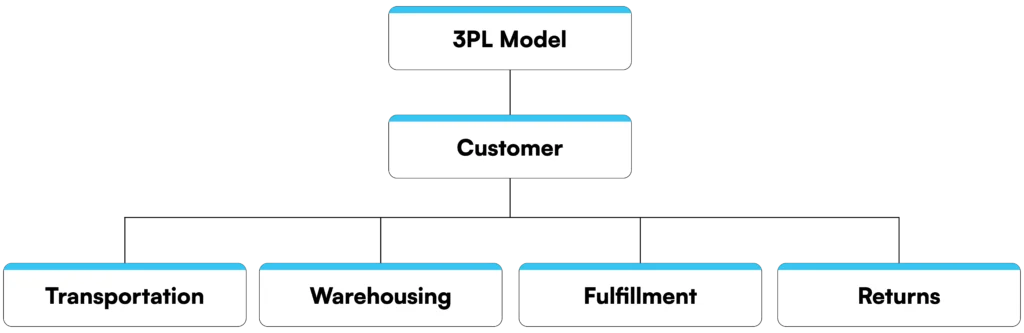
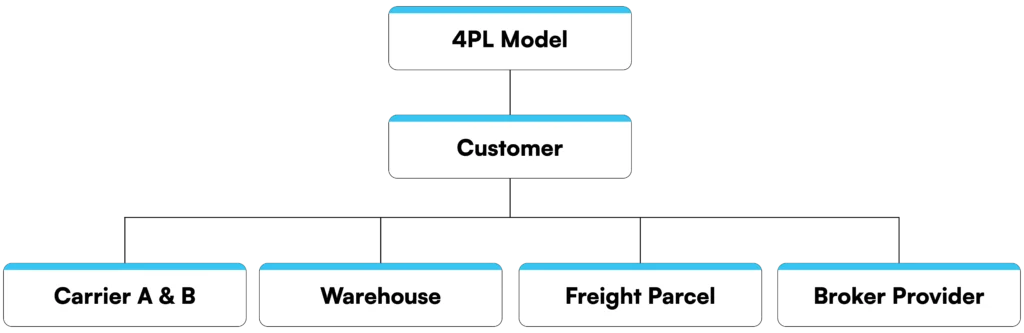
A 3PL may handle freight, warehousing, order fulfillment, or returns. Your team still looks after the wider operation. A 4PL works at a different level. It does not just handle one part of the job. It helps keep the carriers, warehouses, and other logistics providers working together. It may also watch performance and step in when one problem starts affecting more than one part of the supply chain.
One thing that often gets misunderstood is this: a 4PL does not usually replace the carriers or 3PLs already in place. In many cases, those providers stay the same. The 4PL helps keep their work connected, keeps people on the same page, and cuts down the communication gaps that can slow everything down.
The main 3PL vs. 4PL logistics services differences come down to the work and who owns it. A 3PL handles the part it was hired to do. A 4PL helps keep the different parts moving together. There can still be some overlap. Many 3PLs also offer planning, reporting, and technology. That can make the operation easier to see, but it does not replace clear ownership when something goes wrong.
Someone still has to step in, make the call, and keep things moving when the plan falls apart.
How 3PL and 4PL Fit Different Industries
The answer can look different from one operation to another. E-commerce teams are watching orders. Retail teams are watching stock. Manufacturers are watching the production line.
Here is how the choice may look in each one.
E-Commerce
An e-commerce company may bring in a 3PL to store products, pack orders, ship parcels, and deal with returns. That may be enough when inventory planning stays in-house, and the network is still simple. As the business expands into Amazon, Shopify, Walmart Marketplace, direct sales, and wholesale, logistics coordination gets harder to manage.
The 4PL vs 3PL question starts to matter once there are more sales channels, suppliers, warehouses, and carriers in the mix. One late inbound load can leave several sales channels short on stock.
The customer does not see any of that. They only know the product was unavailable or the order arrived late.
Retail
Retail teams are trying to keep stores stocked while also filling online orders. Promotions, seasonal demand, appointments, and returns all add more moving parts.
A 3PL may run a distribution center or deliver stock to stores. A 4PL may help when several providers are moving the same inventory across the network.
Without clear coordination, one store may have too much stock while another loses sales. The product is available. It is just in the wrong place.
Manufacturing
Manufacturers often bring in a 3PL for inbound loads, storage, and shipping finished products. Their own team may still be the one calling suppliers, watching the production schedule, and sorting out urgent freight when something slips.
The 3PL vs 4PL logistics choice matters when material flow gets harder to manage. One missed pickup can slow production and lead to costly last-minute shipping.
We’ve seen companies go with the lowest freight rate, then spend far more fixing what came after. A missed production window can bring premium freight, idle labor, late orders, and unhappy customers. The rate matters, but it is only one part of the total supply chain cost.
At InstiCo, we start by looking at where the operation is getting harder to manage. It may be order flow, store inventory, inbound materials, or too many providers. From there, we help put the right support around the operation.
3PL vs 4PL Logistics Difference Benefits Comparison
The main difference is not how many services appear in the proposal. It is how much responsibility the provider takes once the work starts.
This 3PL vs 4PL logistics difference benefits comparison gives a simple view.
Area | 3PL | 4PL |
Main role | Handles a defined part of the logistics work | Keeps the wider operation connected |
Services | Freight, warehousing, fulfillment, and returns | Provider management, planning, reporting, and exception support |
Daily control | More control stays with the customer | More of the day-to-day coordination moves to the provider |
Visibility | Focuses on the work it handles | Pulls information together across providers |
Decisions | The customer makes most decisions across the network | The provider may act within agreed limits |
Accountability | Owns the part it was hired to manage | Takes wider responsibility across the operation |
Technology integration | The customer usually manages the systems | The provider often connects systems across partners |
Scalability | The customer adds and manages providers one at a time | The provider helps grow the network as one setup |
Best fit | Clear needs with a team that can manage the handoffs | Several providers, systems, or locations to coordinate |
Tradeoff | More work stays with the internal team | More cost and more reliance on one partner |
Many 4PL providers now pull information from carriers, warehouses, and other logistics partners into one view. Instead of checking several systems or waiting on separate updates, the team can follow shipment status, inventory movement, carrier performance, service levels, and open issues in one place. That makes it easier to catch a problem early, before it starts affecting customers.
A 4PL can take pressure off the internal team. But that extra layer needs to solve a real problem. When the work is clear and the team can manage the handoffs, a good 3PL may be enough.
According to the 2025 MHI Annual Industry Report, 55% of supply chain leaders planned to increase spending on technology and innovation. The point is not to keep adding software. It is to give teams one clearer view across carriers, warehouses, and providers, then make sure someone owns the next step when a problem shows up.
How to Choose Between 3PL vs 4PL Logistics
A bigger company does not always need a 4PL. A large manufacturer may already have a team that can manage several 3PLs. A smaller retailer with several sales channels may need more help much sooner.
We’ve worked with companies that thought they had a carrier problem. Once we looked across the operation, the carrier was not the main issue. Purchasing, warehousing, and transportation were not staying connected, and no one clearly owned the updates between them. Once those handoffs were cleaned up, service improved without changing providers.
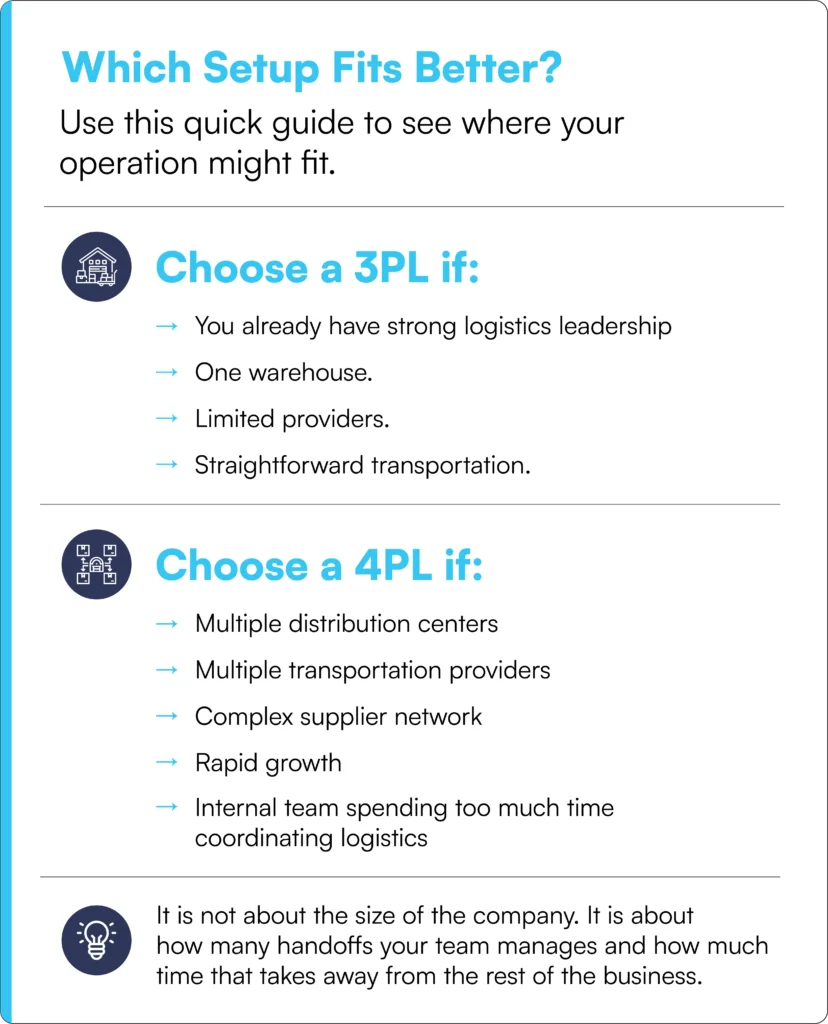
When looking at 4PL vs 3PL logistics, ask:
- Who does the work?
- Who keeps the providers connected?
- Who makes the call when something changes?
- Who owns the result?
A Quick Handoff Check
Think about the last shipment that did not go as planned.
- Who spotted the issue first?
- Who called the carrier?
- Who checked the inventory?
- Who updated the customer, store, or plant?
- Who approved the extra cost?
- Who stayed with it until the issue was closed?
If those steps sit with several different people, the problem may not be the carrier or warehouse alone. The gap may be in the handoffs between them. A 3PL may fit when the work is clear, and your team can manage those handoffs. A 4PL may fit when follow-ups, system gaps, and daily issues are pulling people away from customers and the main operation.
Some companies use both. They keep planning and making bigger decisions in-house while one partner manages transportation, a region, or another part of the network. I would stop the section there. The final paragraph about “better execution, more coordination, or clearer roles” repeats what the callout and handoff check already show.
Conclusion
The best logistics model is not decided by company size. It comes down to how complicated the operation has become.
Companies that can see where responsibility starts to break down usually make better logistics decisions than companies looking only at the freight rate. A low rate may look g
ood on paper, but it does not help much if your team is still chasing updates, fixing handoffs, or paying for missed service later.
There is no automatic winner in the 3PL vs 4PL decision. A 3PL may be enough when the work is clear, and the internal team can manage the wider operation. A 4PL may make more sense when several providers, systems, and locations need to stay connected.
At InstiCo Logistics, we help bring those moving parts together. We keep up with the carriers, warehouses, providers, and daily follow-up so issues do not sit between teams. The goal is simple: clearer ownership, fewer loose ends, and a logistics setup that keeps working as the business grows.
FAQs
What is 4PL vs 3PL in simple terms?
When people ask what 4PL vs 3PL is, the main difference is scope. A 3PL handles specific logistics work. A 4PL coordinates a wider operation and may manage several providers.
Can a business work with both a 3PL and a 4PL?
Yes. A business can use 3PLs for freight and warehousing, then have a 4PL keep the different providers working together. The bigger planning calls can still stay with the company’s own team.
Does a 4PL own trucks?
Not always. Many 4PLs do not own trucks or warehouses. Their role is usually to manage the carriers, 3PLs, systems, and other providers already involved in the operation.
s a 4PL more expensive than a 3PL?
Sometimes. A 4PL usually takes on more coordination, so the management cost may be higher. But the total operating cost can come down when there are fewer missed handoffs, less premium freight, and less time spent chasing providers.