Europe is missing more than 400,000 drivers, and criminals are cashing in. For years, the truck driver shortage has been viewed as a workforce problem. Fewer drivers, tighter capacity, and growing pressure on freight networks, but there’s another side to the story.
The opportunity for fraud has increased with logistics teams working faster to keep freight moving. More spot market activity, new carrier relationships, and less time for verification have created gaps that bad actors know how to exploit.
What started as a staffing challenge has quietly become a much bigger freight risk issue, with the wider impact of freight fraud now estimated in the billions.
But the shortage may be most visible in Europe, and the risks it exposes aren’t limited by geography. Shippers across North America are also familiar with many of the same pressures, including tight capacity, fast carrier onboarding, and growing trust in third-party networks.
Is There Actually a Truck Driver Shortage in Europe?
At this point, the question isn’t really if there is a truck driver shortage in Europe anymore, but simply how long it’s going to last.
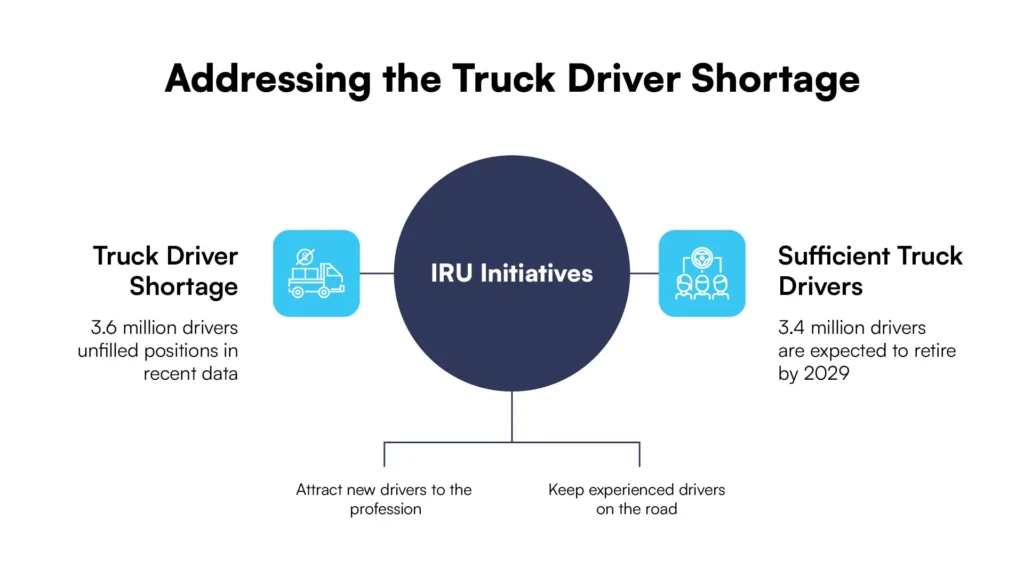
The International Road Transport Union (IRU) has been consistent about the scale of the issue. Around 3.6 million truck driver positions were reported unfilled globally in recent data, and more than 3.4 million drivers are expected to retire by 2029.
That’s not a short-term gap, and Europe is right in the middle of it. Operators across the region keep reporting the same thing. That finding drivers is harder than keeping customers. Some fleets are sitting on demand they can’t fully serve, not because the freight isn’t there but because the capacity isn’t. What makes it more complicated is the structure of the workforce itself.
A large portion of experienced drivers are aging out of the industry. Meanwhile, fewer younger drivers are entering. For many younger workers, the job simply doesn’t offer the lifestyle or flexibility they’re looking for. Even when hiring improves slightly, it doesn’t really close the gap. What used to be treated as a temporary imbalance is now something closer to a permanent condition. And once that happens, everything around freight starts to adjust.
How the Driver Shortage Broke Trucking’s Safety Net
The impact of the driver shortage in trucking industry doesn’t always show up where people expect. It’s not just longer delivery times or higher freight rates. It’s what happens behind the scenes when operations get stretched.
When teams are working under constant capacity pressure, speed often becomes the priority. Carrier onboarding is quicker, new relationships are formed more often, and there is less time for the additional checks that used to be routine. Most of the time, those changes keep risk under control.
When capacity gets tight, teams don’t have much choice. They start widening their carrier base. They work with new partners more often. They rely more heavily on spot freight to fill urgent gaps. None of that is unusual on its own. In fact, it’s how the system stays flexible, but it also changes the rhythm of how freight decisions are made.
Things that used to take time, like carrier checks, relationship validation, and slower onboarding, are starting to get quicker. Not because anyone wants to skip steps, but because the load still needs to move.
That’s also why strong carrier relationships, consistent verification, and ongoing visibility matter more than ever when networks start expanding.
IRU operator surveys reflect this pressure as well, with many European companies reporting that capacity constraints are directly limiting their ability to grow and stabilize operations.
At this point, the impact of the shortage begins reaching areas that have little to do with hiring and much more to do with visibility and control.
How Criminals Turn a Staffing Problem Into a $40B Heist
Cargo crime doesn’t usually start with trucks or physical theft anymore. It starts earlier in the gaps created by speed.
Recent intelligence from TAPA EMEA reported 430 cargo crime incidents across Europe, the Middle East, and Africa in a single 31-day period, with reported losses exceeding €36.8 million. For fraudsters, capacity pressure can become an advantage.
The Fake Carrier Playbook: Spoofed Domains and Cloned Identities
One of the most common tactics today is impersonation. Not new companies, just fake versions of real ones. A cloned website, a slightly modified email domain, or a carrier profile that looks familiar enough to pass a quick check. Sometimes the difference is as small as one letter in a web address that nobody notices until it’s too late. That’s exactly what makes the tactic effective. Because when teams are under pressure, details get missed.
How Phishing Takes Over Legitimate Carrier Accounts
Some of the more serious cases don’t involve fake companies at all. They involve real ones. A single phishing email can be enough to compromise a dispatch account or business inbox. Once inside, attackers don’t need to create anything new. They just operate inside what already exists. That’s where freight stops looking suspicious because everything is technically real. Just controlled by the wrong side. Unusual login activity, last-minute contact changes, or unexpected payment requests can often be early signs that something isn’t right.
Why the Spot Freight Market Is the Perfect Crime Scene
The spot market exists because transportation is unpredictable, but it also runs on speed. And speed is where verification becomes thin. The issue isn’t the spot market itself, but the lack of continuous verification when new carrier relationships are formed quickly. That’s also where most truck driver shortage solutions tend to focus on capacity, while the risk that comes with faster onboarding often gets less attention.
Why One-Time Carrier Verification Is No Longer Enough
Most compliance systems were built for a slower version of logistics. Such as the carrier submitting documents, insurance is checked, the file getting approved, and so on. But that assumes nothing changes after onboarding.
And in today’s freight environment, everything changes. A carrier can be legitimate on Monday and compromised later. Emails get attacked, domains get hacked, and passwords get stolen. That’s why static checks are starting to fail quietly. Continuous monitoring, like tracking changes in carrier details, flagging unusual account activity, and re-verifying key documents, over time is becoming more relevant than one-time approvals.
Practical Responses to Truck Driver Shortage Risk
There’s no single fix for the projected truck driver shortage in 2026 in Europe. Most solutions still sit on the workforce side. Better recruitment, stronger training pipelines, and more structured entry paths into trucking all play a role.
But by this point, most of the article isn’t about understanding the problem anymore. It’s about what can actually be done when capacity is already tight in real operations. That usually starts with how carriers are handled after they join the network, not just how they are brought in.
Moving From One-Time Onboarding to Continuous Verification
One shift that’s starting to stick is simple. Verification doesn’t stay one-time anymore, but it continues. Carriers are checked and monitored over time instead of being approved once and left unchanged. That helps reduce blind spots when things move fast.
The Role of Logistics Platforms in Closing the Security Gap
As networks grow, manual tracking stops being enough. That’s where logistics platforms become more important, not just for speed, but for control. Instead of relying on scattered emails or static records, teams get a clearer view of carrier activity as it changes. This helps find odd behavior earlier and keeps decisions from being based on old information. It does not remove risk, but it makes it easier to stay aware of what’s happening.
Can Technology Actually Fix the Driver Shortage Long-Term?
Technology helps efficiency, but it doesn’t replace drivers. Tools like route optimization, digital onboarding, and capacity matching help make better use of what already exists. Still, structural gaps remain, especially in specialized operations where experienced drivers and reliable carrier capacity are difficult to replace.
Instico follows a clear idea, and that is carrier trust shouldn’t stay static after onboarding. Instead of treating verification as a one-time step, it focuses on keeping carrier information active and visible as things change over time. That way, teams can stay aware of updates in carrier status and reduce the gaps that usually appear when networks move fast.
Conclusion
The truck driver shortage in Europe is not something the industry is trying to understand. Most teams already live with it every day. What’s becoming harder to ignore is what it is doing to everything around freight.
Capacity stays tight, decisions get faster, carrier networks keep expanding, and in that movement, the space between “trusted” and “unverified” gets thinner than it used to be, and that’s where the real shift is happening. Not in the shortage itself, but in how freight operations are adjusting to it.
And once operations start running at speed instead of certainty, risk doesn’t enter loudly. It just blends in, which is the part the industry is dealing with now.
As freight networks get more complex, it becomes harder to keep clear visibility on every carrier. Instico supports logistics teams staying on top of carrier verification and ongoing checks so risks don’t slip through unnoticed.
Explore how Instico can help improve visibility and control across your carrier network.